
Ncert Solutions For Class 6 Maths Chapter 14 Practical Geometry Ex 14.4 Practical Geometry Exercise 14.4 Ncert Solutions For Class 6 Maths Chapter 14 Practical Geometry Ex 14.4 Chapter 14 Practical Geometry Class 6 Chapter 14 Maths Chapter 14 Class 6 Maths Maths Class 6 Chapter 14 Maths Chapter 14 Class 6 Ncert Maths Class 6 Chapter 14 Ncert Solutions For Class 6 Maths Chapter 14 Practical Geometry Class 6 Maths Chapter 14 Practical Geometry Ex 14.4 Class 6 Maths Ncert Solutions
NCERT Solutions for Class 6 Maths Chapter 14 Practical Geometry Ex 14.4
Question 1.
Draw any line segment AB¯¯¯¯¯¯¯¯ . Mark any point M on it. Through M draw a perpendicular to AB¯¯¯¯¯¯¯¯. (use ruler and compasses).
Solution :
Step 1. Given a point M on any line AB¯¯¯¯¯¯¯¯.
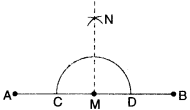
Step 2. With M as centre and a convenient radius, construct a part circle (arc) intersecting the line segment AB¯¯¯¯¯¯¯¯ at two points C and D.
Step 3. With C and D as centres and a radius greater than CM, construct two arcs which cut each other at N.
Step 4. Join MN¯¯¯¯¯¯¯¯¯¯. Then MN¯¯¯¯¯¯¯¯¯¯ is perpendicular to AB¯¯¯¯¯¯¯¯ at M, i.e., MN¯¯¯¯¯¯¯¯¯¯ AB¯¯¯¯¯¯¯¯.
Question 2.
Draw any’line segment PQ¯¯¯¯¯¯¯¯. Take any point R not on it. Through R draw a perpendicular to PQ¯¯¯¯¯¯¯¯. (use ruler and set-square).
Solution :
Step 1. Let PQ¯¯¯¯¯¯¯¯ be the given line segment and R be a point not on it.
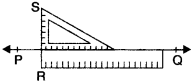
Step 2. Place a set-square on PQ¯¯¯¯¯¯¯¯ such that one arm of the right angle aligns along PQ¯¯¯¯¯¯¯¯.
Step 3. Place a ruler along the edge opposite of the right angle.
Step 4. Hold the ruler fixed. Slide the set-square along the ruler all the point R touches the arm of the set-square.
Step 5. Join RS along the edge through R, meeting PQ¯¯¯¯¯¯¯¯ at S. Now RS¯¯¯¯¯¯¯ PQ¯¯¯¯¯¯¯¯.
Question 3.
Draw a line l and a point X on it. Through X, draw a line segment XY¯¯¯¯¯¯¯¯ perpendicular to l. Now draw a perpendicular to XY at Y. (use ruler and compasses)
Solution :
Step 1. Given a point X on a line l.
Step 2. With X as centre and a convenient radius, construct a part circle (arc) intersecting the line l at two points A and B.
Step 3. With A and B as centres and a radius greater than AX, construct two arcs which cut each other at Y.
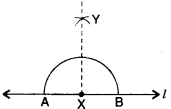
Step 4. Join XY¯¯¯¯¯¯¯¯. Then XY¯¯¯¯¯¯¯¯ is perpendicular to l atX, i.e., XY¯¯¯¯¯¯¯¯ l.
Question 1
Draw an angle of 40°.
Construction Steps
- Draw a ray OA.
- Place the protractor on point O.
- Mark the point at 40°.
- Join the mark with point O to form ray OB.
Result
∠AOB=40∘\angle AOB = 40^\circ
Question 2
Draw an angle of 125°.
Steps
- Draw ray PQ.
- Place the protractor correctly.
- Mark the point at 125°.
- Draw another ray through the mark.
Result
∠QPR=125∘\angle QPR = 125^\circ
This is an obtuse angle.
Question 3
Draw an angle of 90°.
Steps
- Draw a base ray.
- Use the protractor to mark 90°.
- Draw the second ray through the mark.
Result
∠XYZ=90∘\angle XYZ = 90^\circ
This is a right angle.
Question 4
Draw an angle of 150°.
Steps
- Draw ray AB.
- Place the protractor at point A.
- Mark 150°.
- Join the mark to point A.
Result
∠BAC=150∘\angle BAC = 150^\circ
This is an obtuse angle.