
Ncert Solutions Chapter 5 Understanding Elementary Shapes Ex 5.5 Ncert Class 6 Maths Chapter 5 Exercise 5.5 Ncert Maths Class 6 Chapter 5 Exercise 5.5
NCERT Solutions for Class 6 Maths Chapter 5 Understanding Elementary Shapes Ex 5.5
Question 1.
Which of the following are models for perpendicular lines :
(a) The adjacent edges of a table top.
(b) The lines of a railway track.
(c) The line segments forming the letter “L”.
(d) The letter V.
Solution :
(a) and (c) are models for perpendicular lines.
Question 2.
Let PQ¯¯¯¯¯¯¯¯ be the perpendicular to the line segment XY¯¯¯¯¯¯¯¯ . Let PQ→ and XY¯¯¯¯¯¯¯¯ intersect in the point A. What is the measure of ∠PAY ?
Solution :
The measure of ∠PAY is 90°.
Question 3.
There are two “set-squares ” in your box. What are the measures of the angles that are formed at their comers? Do they have any angle measure that is common?
Solution :
One is a 30° – 60° – 90° set square; the other is a 45° – 45° – 90° set square. The angle of measure 90° (i.e., a right angle) is common between them.
Question 4.
Study the diagram. The line l is perpendicular to line m.
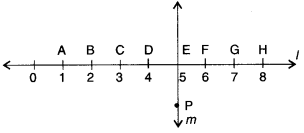
(a) Is CE = EG?
(b) Does PE bisect CG?
(c) Identify any two line segments for which PE is the perpendicular bisector.
(d) Are these true?
(i) AC > EG
(ii) CD = GH
(iii) BC < EH.
Solution :
(a) CE= CD + DE
= 1 + 1=2 units
EG = EF + FG
= 1 + 1=2 units
∴ CE= EG
(b) ∴ CE = EG
∴ E is the mid-point of CG.
∴ Line PE bisects line segment CG
(c) ∴ DE = EF = 1 unit
∴ PE is the perpendicular bisector of line segment DF
∴ BE = EH = 3 units
∴ PE is the perpendicular bisector of BH
(d)
(i) true
(ii) true
(iii) true
Question 1
Identify the vertex in angle AOB
Solution
In:
∠AOB\angle AOB
The vertex is the middle point.
Answer:
OO
Question 2
Name the arms of angle AOB
Solution
The arms are:
- OA
- OB
Answer:
OA and OBOA \text{ and } OB
Question 3
Identify angle in real life objects
Examples:
- Open book
- Clock hands
- Scissors
These all form angles.
Question 4
Which has a larger opening?
Compare two angles: one narrow and one wide.
Solution
The wider opening is greater.
Answer:
Greater angle is the one with wider opening\text{Greater angle is the one with wider opening}
Understanding Angle Formation
An angle is formed when:
- Two rays start from one point
- They open in different directions
Visual idea:
∠AOB\angle AOB